


The Constant Battle: The Mental Adversities of Professional Rugby
- chrisbenn03
- Apr 10, 2024
- 5 min read
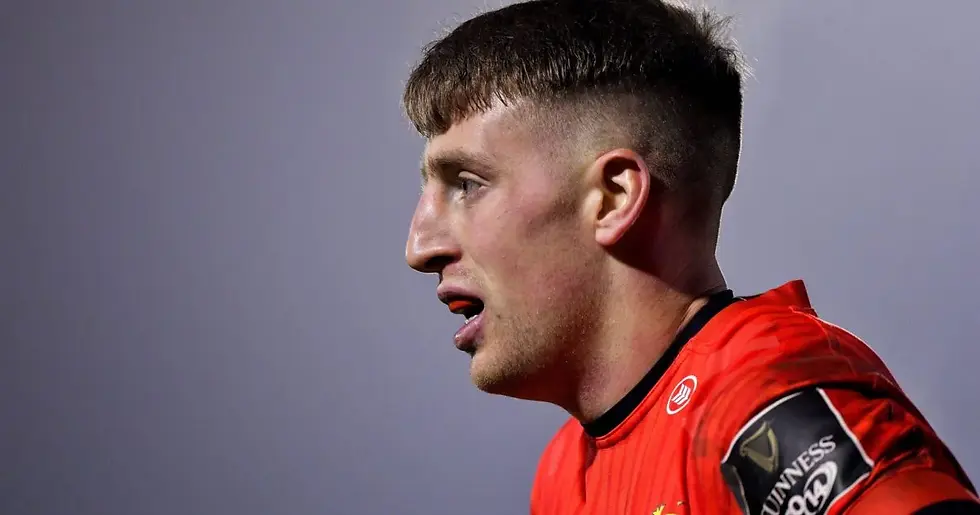
Photo by Brendan Moran/Sportsfile
If there was a rugby hell it would probably credit Liam Coombes’ last 14 months for its inspiration. His injury report would make any outside back wake in a cold sweat. This makes it all the more impressive that he never once came across as bitter or fed up while discussing his hellish year-and-a-half stay in the rehab room. A stay so long a sympathetic judge would afford him squatters’ rights. In fact, he was outwardly positive about the whole ordeal.
Despite having fractured his fibula playing for Garryowen, only to endure the same injury in his first training back, Liam reiterates that it was only in the last year and a half when his injury woes truly began. Let's just list them off for the sake of time.
May 2022, torn toe ligament (a self-admitted “strange one”),
June – December 2022, multiple low-grade hamstring tears,
February 2023, the “big one”, a high-grade hamstring tear,
Summer of 2023, calf tear, multiple low-grade hamstring tears,
November 2023, dislocated shoulder.
A mere 38 minutes of rugby in 14 months. Less than a full half of rugby for a professional athlete in close to a year and a half. It’s almost comical, Liam seems to agree as he laughs while listing his injuries. Better to laugh than cry I suppose.
Injuries can be a brutal obstacle to navigate as a young rugby player. Often players can make it all the way through underage rugby, the school system, and into the professional pipeline without encountering a serious injury. That makes their inevitable encounter with injury trouble even more challenging.
Unfortunately for Liam, the shoe fits. When reminiscing back to his younger playing days with Skibbereen RFC, he smiles ruefully, “I had very few injuries. I don't know how because I was playing football and rugby at a high level every night of the week. I'm jealous of who I was back then”.
When young athletes begin to break down and get injured, they oftentimes haven't developed the mental skills to cope with it yet. While talking to Tom Painter, a Mental Skills Coach working in the South Africa Rugby Schools system, he explained that “especially during teenage years, through to even early 20s, the social impact of injury can be particularly challenging. Particularly if sport is for them, a key social outlet”.
Going through this process as a young athlete in a high-performance environment brings its own challenges, Painter explains, “In a professional environment the consequences of being out from injury can be more than disappointment, there can be real-world financial consequences....in High-Performance environments, coaches, managers and investors can and will push athletes to return sooner than is both mentally and physically safe. The pressure and money factor unfortunately often de-prioritise the welfare of players.”
He prefaces that this is highly dependent on the club, country, and situation, however. South Africa, where he works, is infamous for their disregard of player welfare with countless steroid scandals in recent years, from schoolboys up to established Springboks, such as Elton Jantjies.

Liam Coombes celebrates after his incredible solo effort try against the Emirates Lions in January 2023. Credit: Inpho
Rehab can be a lonely time as an athlete, according to Painter, who holds a master's degree in Mental Skills and Mental Health in Sports and Exercise from the University of Limerick, “the higher up the amateur/elite continuum a player goes, the more their identity as an athlete begins to consume who they are. Friends and family are a critical voice from outside the arena, that can re-ground an athlete in a healthier self-identity. For example, they are not just an athlete, but a brother, sister, wife, father etc.” Coombes agrees, stating “I find talking to people helps a lot on the mental side of it”.
When asked if the rehab process can be isolating the Skibbereen man echoed the professional’s words, “It can be. It can change from week to week. It makes the session a lot harder [training alone]. When there's other guys there, you're like, I need to be better than them. You get them going or they get you going. I suppose when you're on your own you have to rely completely on yourself.”
An athlete's biggest fear often surrounds selection when struck with a long-term injury. The South Africa-based coach meets this daily in his career, as both a head coach and a sports psychologist. He had this to say on the issue, “As we often hear on commentary, injury replacements have ‘their chance to prove themselves’... What can make this more debilitating is if they are semi/fully professional - it is a question of livelihood at times. The damaging aspect of this is of course that it is out of their control, so frustration and anger can be really difficult to manage.”
The Munster flyer has been forced to deal with that mental battle over the past 14 months but said, “Thankfully, I feel like I've built up a small bit of trust with the coaches at this stage. It might have been more difficult when I was younger.” Injuries are a part of all professional sports, especially ones as physical as rugby. “It really is part of the game. I know I've probably been more unlucky than most in the last couple of years but everyone goes through these patches.” says the 26-year-old.
Injury comes in swings and roundabouts, and Coombes has experienced both. He received his sole Irish u20 cap as a result of an injury to current clubmate Colm Hogan. He was quickly parachuted in to start against New Zealand U20s in the 2017 World Championship. The Garryowen man’s first senior appearance also came due to injury, replacing a concussed Sammy Arnold in the starting team in Munster’s away fixture versus the Cheetahs in 2018.
Painter explained that the “core psychological skills and processes that are well linked to recovery are goal setting, attentional control, self-talk and visualization”. The Mental Skills Coach, speaking on the importance of visualization, said, “Often athletes are quick to forget ‘what it feels like’ to be on the field, doing what they do best. Drawing on all the senses to make a vivid picture of that moment running out to play, or lining up that crucial game-winning penalty can help keep the athlete immersed in the sensory experience that they yearn for while injured, this is known as the ‘functional equivalence hypothesis’”.
Coombes stressed that even with a constant barrage of injuries, there are ways to frame it positively and improve as a player, “It can work out positively in terms of giving you time to work on other things as well. In terms of, if I have a shoulder injury, because I've had so many hamstring injuries in the past, it's given me a chance to bulletproof that. I've been able to do more work on that because of this.” This framing isn’t always easy and was developed over many sessions with Cathal Sheridan, Munster’s Senior Sport Psychologist. "I use him all the time if I'm feeling like it's getting a bit too much. He's very good.”, the Skibbereen native admits.
Professional physios have been forced to upskill in recent years to educate players, such as Coombes, on the mental skills associated with recovery. The Garryowen club man has had the help of his experienced teammates, Andrew Conway, and Keith Earls, saying, “You learn off [of] other guys, off [of] how they approach injuries”.
Thankfully talk about mental health has become more prominent in recent years, as showcased by Coombes’ brilliant understanding and openness of the process. Painter agrees, saying, “Mental Health, in general, has become a much more common theme in the sporting dialogue - whether or not accepted”. There’s the crux of the issue. “Whether or not accepted”. Munster has cultivated an environment that is accepting of this increasingly important facet of life, in the game and outside of it. It is up to other teams to follow suit and not enhance the difficulty of young players trying to break into the system, by refusing to take a holistic approach to an athlete's health.


Comments